
DIMA Connect | Issue 14: COP31 — Africa’s Adaptation Test
- November 17, 2026
- Posted by: Gravitazz Continental Online
- Category: Uncategorized

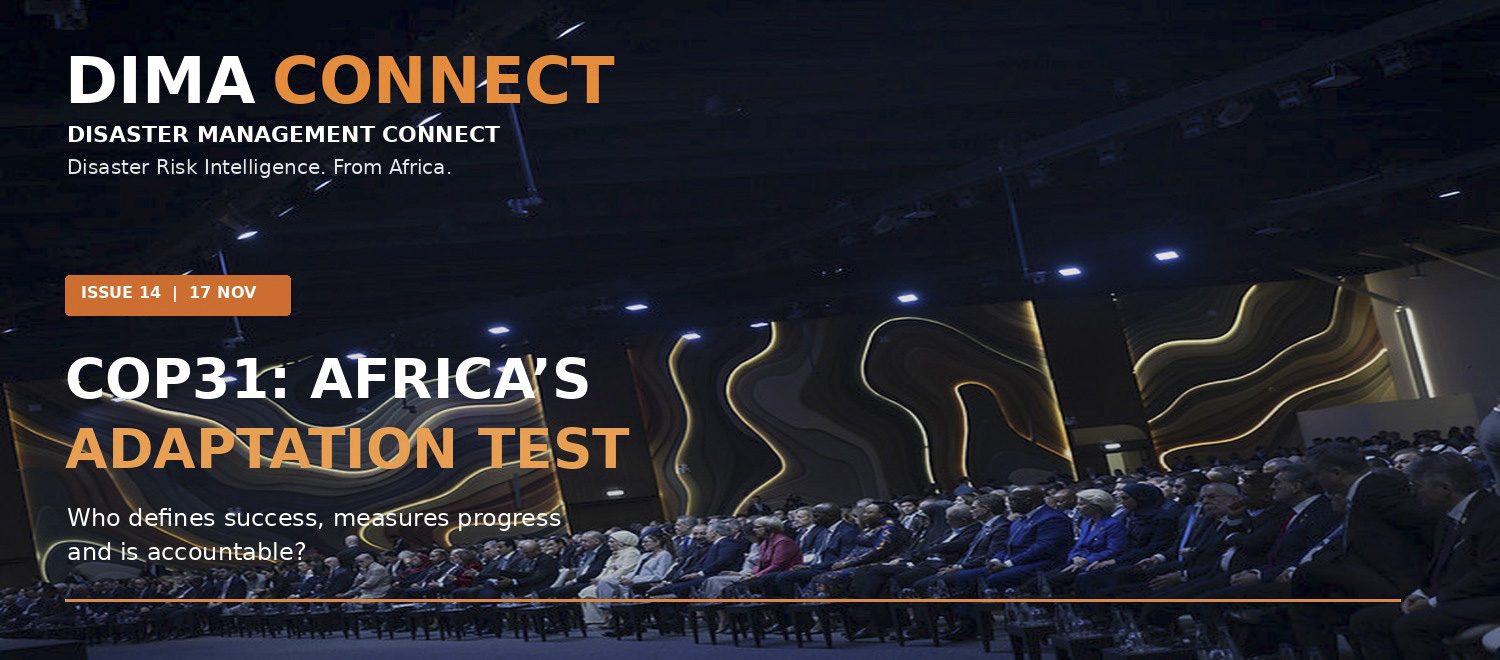
DIMA CONNECT / ISSUE 14 / 17 NOVEMBER 2026
COP31: AFRICA’S ADAPTATION TEST
Beyond climate promises: who defines success, who measures progress, and who is accountable?
DISASTER RISK INTELLIGENCE. FROM AFRICA.
Download the complete Issue 14 PDF
COP31: African negotiators contest who shapes adaptation metrics and how implementation support will be tracked. Africa Day: water security and resilient infrastructure move into focus. SADC: ministers address contingency planning and regional logistics. East Africa: ICPAC identifies sharply differentiated rainfall and flood risks. Opportunities: selected calls separated by applicant type.
Editorial cut-off: 17 November 2026, 09:00 SAST. COP31 was ongoing at this cut-off; negotiating positions are not final decisions.
DIMA LENS | COP31 and the meaning of adaptation
Who decides what counts as resilience?
COP31 in Antalya has moved beyond broad commitments to the mechanics of implementing the Global Goal on Adaptation (GGA). The dispute is not simply over a target: it concerns the indicators used to describe progress, the experts authorised to refine them and the resources available to countries expected to report results.
During negotiations on 16 November, the African Group resisted a process led by international organisations or constituted bodies for selecting the adaptation technical taskforce. Different negotiating groups favoured regional nominations, representation for least-developed countries and small island states, or selection by subsidiary-body chairs. This is an institutional question with practical consequences: whose experience shapes the indicators used to evaluate national adaptation?
The G77 and China called for a baseline, methodology and tracking of the commitment to triple adaptation finance. Other groups preferred handling these issues in finance negotiations. These positions were under discussion at the editorial cut-off, not adopted COP31 outcomes.
Why the measurement question matters
A country can report a climate plan, a new forecast system or kilometres of drainage without proving that fewer households are exposed, hospitals remain operational or communities recover faster. Conversely, weak national data can obscure genuine local improvements. DIMA’s test is whether indicators connect national commitments to the people and systems that face the risk.
Three decisions to watch
- Who nominates the experts refining adaptation indicators?
- Will the tracking framework distinguish investments from measurable reductions in vulnerability?
- Will finance rules support data-poor and low-capacity countries without creating another unfunded reporting burden?
Source: IISD Earth Negotiations Bulletin, 16 November 2026
AFRICA AT COP31 | Water, cities and accountability
The African Union’s Africa Day at COP31 on 14 November put water security, climate resilience and accessible investment at the centre of the continent’s agenda. The approach links the negotiations to everyday systems: water supply, sanitation, energy, transport and urban services. As COP32 approaches in Addis Ababa in 2027, the test is whether this political agenda yields investable programmes and measurable protection.
Source: African Union, Africa Day at COP31, 14 November 2026.
AFRICA DRR WATCH | Fresh regional signals
Southern Africa — what ministers can operationalise
SADC’s Seventh Ordinary Meeting of Ministers Responsible for Disaster Risk Management on 12 November called for stronger readiness for the 2026/27 rainfall and cyclone season. The practical issues include contingency-plan validation, pre-positioning, humanitarian logistics and the operationalisation of the SADC Humanitarian and Emergency Operations Centre. The story this week is institutional follow-through, not another funding-gap headline.
Source: SADC ministerial meeting, 12 November
East and Horn of Africa — one season, different local risks
ICPAC’s 10–17 November outlook indicated above-usual rainfall in much of Kenya, Tanzania and parts of Ethiopia, Somalia, Uganda, Rwanda and Burundi, but below-usual rainfall in other areas of the same countries. It also identified potential flooding in southern Ethiopia, much of Kenya, southern Somalia, central Tanzania and pockets of Burundi and Rwanda. Regional averages can conceal locally opposing hazards; response plans must be tied to subnational forecasts.
Source: ICPAC weekly forecast, 10–17 November 2026.
REGIONAL INSTITUTIONS | Tracking commitments
The East African Community plan reported in Issue 13 set 25 November as the target for a disaster-information dashboard and 30 November for an implementation document. Neither deadline had passed at the Issue 14 editorial cut-off. DIMA will assess delivery after those dates rather than reprint the original announcement as new news.
Source: EAC ministerial announcement
DIMA RISK FINANCE WATCH | Access and effectiveness
The relevant COP31 question is no longer only how much finance is promised. It is whether finance reaches the institutions capable of protecting people, on terms that do not compound fiscal vulnerability. A useful evidence chain is: commitment → approved programme → accessible funding → local implementation → verified risk reduction. A pledge is not a disbursement, and a disbursement is not proof of adaptation impact.
At COP31, the African Group and other developing-country coalitions argued for predictable support and clearer means of implementation. The final negotiating text remained unsettled at the cut-off. DIMA will not attribute a new COP31 finance agreement before one is adopted.
Source: IISD COP31 finance negotiations, 16 November
GLOBAL DRR WATCH | What Africa can learn
Adaptation indicators must capture cascading risks
A climate indicator that measures only flood depth may miss the larger disruption: a damaged substation shuts down water pumping; clinics lose refrigeration; roads delay emergency transport; households lose income. This is a cascading risk pathway, not merely a second hazard. Indicators should therefore examine service continuity, recovery time, exposure reduction and protection of vulnerable groups alongside infrastructure investment.
The UNFCCC’s adopted COP31 agenda includes adaptation, loss and damage, and climate finance. The outcome of the week’s negotiations was still open at the editorial cut-off. The governance lesson for Africa is to design measurement systems that can support decisions before, during and after shocks—not only international reporting.
Source: UNFCCC COP31 conference information
EVENTS & LEARNING | What to follow
- 17–18 November: resumed COP31 high-level segment, Antalya, Türkiye.
- 20 November: scheduled COP31 closing date; final decisions require verification after adoption.
- 25 November: EAC disaster-information dashboard target.
- 30 November: EAC implementation-plan target.
PRACTITIONER QUESTIONS | Four tests for African institutions
- Which adaptation indicator would demonstrate a real improvement in the safety of households?
- Who validates risk data, and can cities access it in time to make decisions?
- Are critical-service interdependencies included in national risk assessments?
- How will ministries demonstrate that COP31 commitments changed budgets, plans or field operations?
PROFESSIONAL OPPORTUNITIES | Firms and individuals
Eight selected opportunities relevant to disaster risk governance, climate resilience and institutional strengthening. Confirm the original employer notice and any deadline changes before applying.
Institutional / firm assignments
- UNICEF Zambia — Shock-Responsive Social Protection Framework — Firm; Zambia; 19 Nov 2026, 23:59 GMT+2. View notice.
- UNDP Burundi — Socio-economic Vulnerability Assessment — National firm; Burundi; 18 Nov 2026. View notice.
Individual consultancies / technical roles
- Action Against Hunger — Climate and Anticipatory Action Modelling — Individual; Nairobi/Horn of Africa; 26 Nov 2026, 17:00 EAT. View notice.
- UNDRR — Extreme Heat Risk Governance — Consultant; Senegal; 20 Nov 2026. View notice.
- ITU — Disaster Preparedness Consultant Roster — Individual; home-based; 31 Dec 2026. View notice.
- UN-Habitat — Cities and Climate Change: Data, Monitoring, Reporting — Consultant; Nairobi; 18 Nov 2026. View notice.
- UNEP — Terminal Review Expert, Madagascar — Consultant; listed deadline 23 Nov 2026. View notice.
- UNDP — Institutional Support and Capacity Building Specialist — International IPSA-11; Cameroon; 23 Nov 2026. View notice.
Some sources are vacancy aggregators; the original employer portal governs eligibility and submission. Listings reflect the 17 November editorial cut-off.
THE DIMA QUESTION
When COP31 ends, what evidence will show that Africa’s adaptation capacity has improved—not just its negotiating language?
ABOUT GRAVITAZZ & THE CONTINENTAL CONSORTIUM
DIMA Connect is published by Gravitazz Institute, drawing on the Gravitazz Continental Consortium — a pan-African network of specialists in disaster risk governance, early warning, climate resilience, risk financing, recovery, institutional assessments, research, training and monitoring and evaluation.
For technical collaboration and contributions: info@gravitazzcontinental.com | gravitazzcontinental.com.
Tracking the risks. Questioning the systems. Connecting the people who manage them.