
DIMA CONNECT | ISSUE 03 — 31 AUGUST 2026
- August 31, 2026
- Posted by: Gravitazz Continental Online
- Categories: Climate Resilience & Early Warning, DIMA Connect, Disaster Risk Management
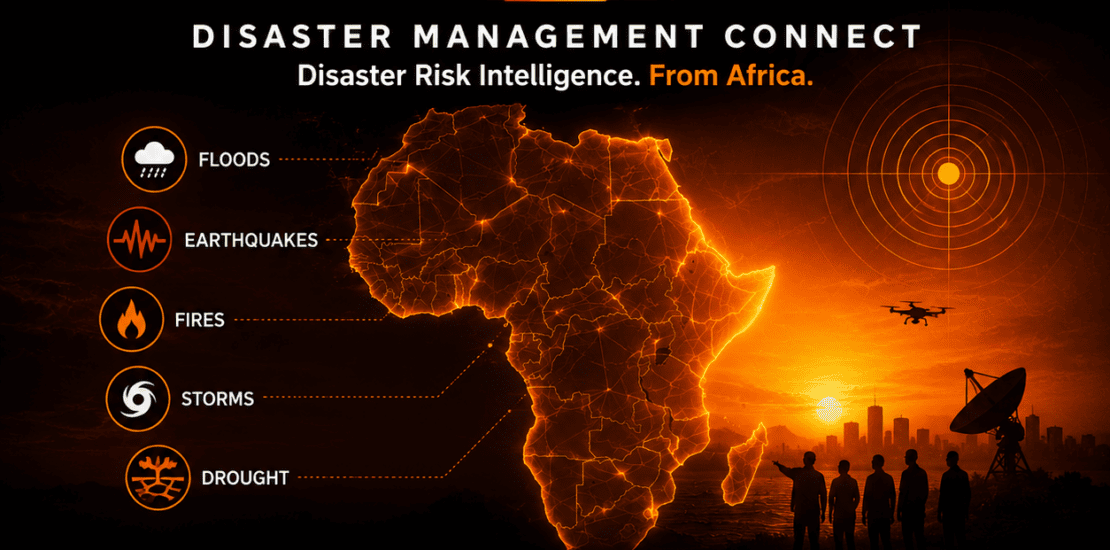
Disaster Management Connect | Disaster Risk Intelligence. From Africa.
The warning is getting clearer. Is institutional action catching up?
Across Africa, the ability to anticipate risk is improving. Seasonal forecasts are becoming more sophisticated, flood alerts more location-specific and early-warning systems more capable. Southern Africa has released its 2026/27 seasonal outlook after SARCOF-33; Nigeria has placed about 2,000 locations under varying levels of flood risk; and Africa’s early-warning community gathers this week in Addis Ababa.
The question is increasingly difficult to avoid:
When we can see the risk coming, what prevents institutions from acting?
IN THIS ISSUE: Africa DRR Watch • DIMA Lens • Regional Institutions • Global DRR Watch • Events & Learning • Professional Opportunities
THE DIMA LENS | FROM WARNING TO ACTION
A forecast is only valuable when it changes what somebody does before the loss occurs.
The DIMA five-stage test is simple:
RISK KNOWLEDGE → FORECAST → TRIGGER → AUTHORITY + FINANCE → EARLY ACTION
The missing link is often not another forecast. It is a pre-agreed mechanism that says: if X happens, Y institution does Z, using these resources, by this time.
An early-warning system should therefore be judged not only by whether a forecast was accurate or a bulletin was issued, but by whether somebody was authorised, financed and prepared to act.
For practitioners, four questions matter:
- When a credible warning is issued, who has authority to act?
- Are trigger-based actions defined, costed and funded in advance?
- Can local authorities spend before an emergency declaration?
- Who is accountable when warning is issued but no action follows?
DIMA INSIGHT: Africa’s next frontier must be not only Early Warnings for All — but Early Action for All.
AFRICA DRR WATCH | 24–30 AUGUST 2026
Southern Africa | SARCOF-33 outlook released
SADC’s 2026/27 seasonal outlook favours drier conditions across significant parts of Southern Africa during important parts of the rainy season, although conditions vary across the region.
DIMA WATCH: The real test now is whether seasonal information enters contingency planning, agriculture and water decisions, preparedness financing and anticipatory-action mechanisms.
Official source: SADC — Seasonal Outlook
Nigeria | About 2,000 locations on flood alert
Nigeria’s National Flood Early Warning Systems Centre has placed about 2,000 locations across 33 states and the Federal Capital Territory under varying levels of flood risk for 27 August–9 September. Of these, 915 communities across 19 states are classified as facing critical risk requiring immediate preparedness and protective measures.
DIMA WATCH: Nigeria’s increasingly granular flood information raises the same institutional question: once authorities know which communities face critical risk, what actions are automatically triggered?
Official source: Nigerian Government flood-risk information
Ghana | Floodwaters recede, health risks remain
WHO delivered emergency health supplies to Ghana’s National Disaster Management Organisation on 28 August following floods that affected 38,802 people and displaced 7,761 households across 25 communities in Greater Accra alone. Public-health concerns include unsafe drinking water, disrupted sanitation, waste accumulation and increased risks of cholera, diarrhoeal disease and malaria.
DIMA WATCH: Disaster impact does not end when floodwaters disappear. Recovery planning must anticipate secondary and cascading health consequences.
Official source: WHO Africa
Guinea | Conakry landfill collapse exposes constructed urban risk
Heavy rain triggered the collapse of a massive waste mound at the Dar Es Salam landfill in Conakry, killing 30 people and injuring others while destroying nearby homes.
DIMA WATCH: Rainfall may trigger a disaster, but vulnerability is often constructed over years through land-use decisions, unsafe settlement, inadequate infrastructure and failures of waste governance.
Source: Reuters
Sudan | Floods compound conflict and displacement
Heavy rain and flash flooding destroyed or damaged homes and displaced families across several locations in North Darfur during August, adding another layer of vulnerability in communities already confronting conflict and displacement.
DIMA WATCH: Sudan demonstrates why disaster risk cannot always be managed hazard by hazard. Flooding, conflict, displacement, damaged infrastructure and weakened public services can interact to create cascading humanitarian consequences.
Source: GDACS
REGIONAL & SYSTEMS WATCH
SADC: SARCOF-33 reinforced the shift from seasonal prediction towards preparedness and early action. DIMA will watch whether Member States translate regional forecasts into national contingency measures, sector advisories, financing decisions and operational triggers.
AU / AMHEWAS: Continental multi-hazard early-warning and risk-information architecture remains central to implementation as Africa moves towards the Early Warnings for All target.
The Africa Early Warnings Forum, taking place in Addis Ababa from 2–4 September, provides an important measure of progress. According to UNDRR, African countries with early-warning systems have increased from 10 in 2015 to 26 in 2026, but significant gaps remain in infrastructure, last-mile communication and sustainable financing.
DIMA SYSTEM SHIFT: The technical capacity to anticipate hazards is improving. The next frontier is institutional: connecting warning information to authority, financing, accountability and early action.
Official Africa Early Warnings Forum page
GLOBAL DRR WATCH | NEPAL–TIBET
Rescuers in Nepal and China continue to confront the consequences of catastrophic Himalayan floods and mudslides following a glacier collapse. By 30 August, the confirmed death toll was nearing 800, while more than 3,000 people remained missing. Rescue operations have been complicated by unstable terrain, damaged infrastructure, flooding and rising water levels.
The disaster has affected settlements, transport systems and hydropower infrastructure, with hundreds also believed trapped in hydropower tunnels.
DIMA LENS: This is not simply a flood story. It is a cascading and transboundary risk event connecting cryosphere instability, debris flows, river systems, settlements, transport infrastructure, hydropower, rescue access and different national jurisdictions.
DIMA LESSON: Disaster planning cannot stop at administrative or national borders when the underlying risk system does not.
Source: Reuters — latest Nepal–Tibet disaster update
EVENTS, LEARNING & DIMA RADAR
2–4 September | Africa Early Warnings Forum — Addis Ababa, Ethiopia
A major continental stocktake of Early Warnings for All, including governance, anticipatory action, financing, innovation and last-mile communication.
Forum information and participation
3–4 September | 6th Global Expert Forum for Producers and Users of Disaster-related Statistics — Geneva / Hybrid
Focus on strengthening disaster-related statistics and their use in risk analysis, policy and decision-making.
DIMA OPPORTUNITIES | LIVE & VERIFIED
Only new opportunities are included. Opportunities published in previous DIMA editions are not repeated unless there has been a material change.
JOB | Assistant Data Specialist, NOA
UNDRR | Cairo, Egypt
Deadline: 7 September 2026
The position supports disaster-risk and resilience analytics, including DELTA-Resilience and Sendai Framework Monitor reporting.
INDIVIDUAL CONSULTANCY | Costed National Hygiene Roadmap & National Hygiene Strategy Review
UNICEF | South Africa / Remote | Nationals only
Deadline: 6 September 2026
The 3.5-month consultancy supports South Africa’s National Department of Health to develop a costed National Hygiene Roadmap and review the national strategy, including policy, coordination, financing, monitoring and service-delivery systems.
VIEW OFFICIAL CONSULTANCY / APPLY
FIRM / EOI | Impact-Based Forecasting System for Climate Risks in Somalia
African Development Bank / SoDMA | Somalia
The assignment will design and demonstrate a national impact-based forecasting framework covering drought and flood, including hazard-to-impact matrices, thresholds, warning levels, trigger logic, early-action guidance, SOPs, data governance and capacity development.
VIEW OFFICIAL AfDB EOI / OBTAIN APPLICATION DOCUMENTS
FIRM / EOI | Climate Disaster Risk Profiles for Four Pilot Districts
African Development Bank / SoDMA | Somalia
The assignment covers four decision-oriented district climate-disaster risk profiles using GIS, remote sensing and existing datasets, with drought and flood as mandatory hazards and analysis of exposure, vulnerability, coping capacity and priority hotspots.
VIEW OFFICIAL AfDB EOI / OBTAIN APPLICATION DOCUMENTS
Opportunities re-verified on 31 August 2026. Always confirm eligibility, deadlines and submission requirements on the official opportunity page.
ONE QUESTION TO TAKE AWAY
If a credible warning arrives weeks or months before impact, at what point does failure to act become an institutional failure rather than a forecasting failure?
ABOUT DIMA CONNECT
DIMA Connect — Disaster Management Connect is a weekly African disaster-risk intelligence brief tracking DRM/DRR, climate resilience, early warning, anticipatory action, humanitarian developments, regional institutions, events and professional opportunities.
Have intelligence for DIMA? Send verified disaster-risk developments, research, events and professional opportunities to info@gravitazzcontinental.com
DIMA Connect is produced by Gravitazz Institute, with contributions from the Gravitazz Continental Consortium — an Africa-led specialist network connecting expertise in risk, resilience, climate, humanitarian action, recovery, data and institutional strengthening.
Need technical support? Gravitazz supports governments and partners through consultancies, research, training, institutional strengthening and consortium development across Africa.
JOIN THE DIMA CONNECT COMMUNITY
Exchange operational intelligence, opportunities, resources and practitioner insight with Africa’s growing disaster-risk community.
JOIN THE DIMA WHATSAPP COMMUNITY
RECEIVE DIMA EVERY MONDAY
Receive the week’s African disaster-risk intelligence, events and professional opportunities.
SUBSCRIBE TO DIMA CONNECT
READ DIMA CONNECT IN YOUR LANGUAGE
English | Français | Português | Kiswahili | + other available languages
Use the language selector on the online edition.
CONTACT / INTELLIGENCE / OPPORTUNITIES
info@gravitazzcontinental.com
www.gravitazzcontinental.com
Tracking the risks. Questioning the systems. Connecting the people who manage them.