
DIMA CONNECT | ISSUE 08 — 6 OCTOBER 2026
- October 6, 2026
- Posted by: Gravitazz Continental Online
- Categories: Climate Resilience & Early Warning, DIMA Connect, Disaster Risk Management, Uncategorized
ISSUE 08 · 6 OCTOBER 2026
Disaster Risk Intelligence. From Africa.
Resilience starts at home.
Who makes it possible?
On 13 October, the world marks the International Day for Disaster Risk Reduction under the 2026 theme Resilience Starts at Home. UNDRR explicitly recognises the responsibilities of governments and the private sector alongside households. The implementation test is whether those responsibilities are financed and enforced. A household can prepare an emergency kit, listen to warnings and reinforce a roof where resources allow. But a household cannot enforce a building code, redesign municipal drainage, prevent unsafe development in a floodplain, or necessarily afford insurance, retrofitting or relocation.
Resilience starts at home — but the conditions for resilience are built far beyond the home.
THE DIMA CONNECT LENS
The home is where risk arrives — not necessarily where it begins. A flood may enter through someone's front door, but the disaster may have begun years earlier: when settlement was permitted in an exposed location; when drainage was not maintained; when a building standard was ignored; when risk information failed to influence planning; or when poorer households had no affordable pathway to safer housing.
DEVELOPMENT DECISIONS SHAPE EXPOSURE AND VULNERABILITY.
WHEN A HAZARD STRIKES, THESE CONDITIONS SHAPE IMPACT, LOSS AND RECOVERY.
Households have responsibilities. So do communities, municipalities, national governments, developers, banks, insurers and social-protection systems. Real resilience emerges when these responsibilities connect.
THE DIMA QUESTION:
When a family loses an unsafe home in a known floodplain, where exactly did the disaster begin?
EDITOR'S NOTE:
Issue 08 opens the October investigation. September asked what happens when risks collide. October asks who builds – and who pays for – resilience.
FROM ESWATINI TO SEYCHELLES: CAN INSTITUTIONAL WEAKNESSES BE FOUND BEFORE DISASTER FINDS THEM?
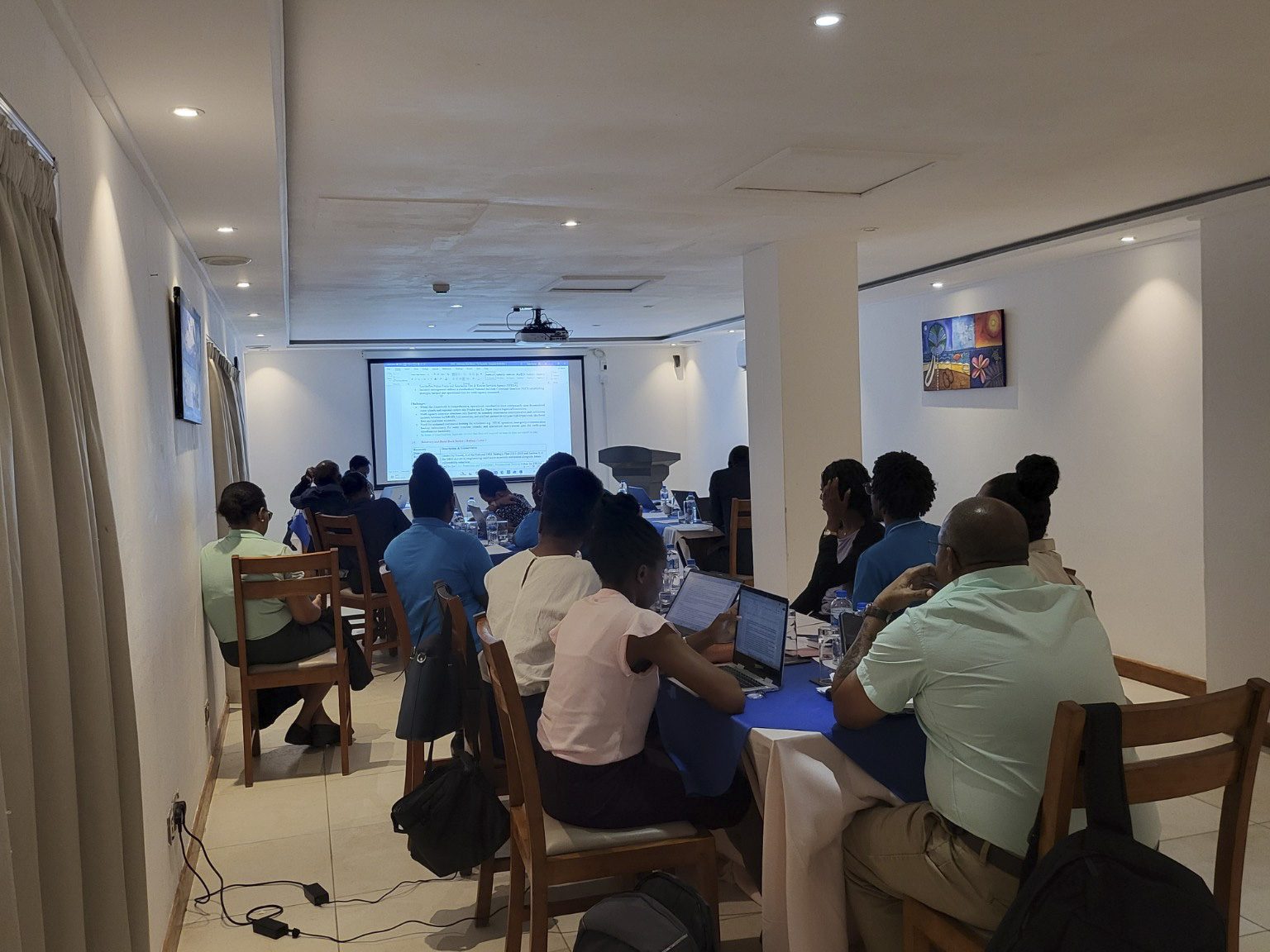
Issue 07 of DIMA Connect followed the SADC Disaster Risk Management Peer Review process in Eswatini. On 29–30 September, the process continued in Seychelles, where national stakeholders examined the institutional machinery through which disaster risk is governed and managed. For a Small Island Developing State, the context is distinctive: concentrated infrastructure and settlement, coastal and flood risks, intense rainfall, landslides, climate pressures and the practical challenge of managing risk across multiple islands. But the peer review is not principally a review of hazards. It is a review of capability.
The system questions
• Are institutional mandates clear?
• Do coordination arrangements function in practice?
• Does risk information enter decisions?
• Are preparedness arrangements operational?
• Do national and local structures connect?
• Are responsibilities matched by authority and resources?
• Can the system identify and correct weaknesses before an emergency exposes them?
FROM THE FIELD:
The strongest disaster-management system is not necessarily the one that claims to have no weaknesses. It may be the one capable of finding and correcting them before disaster does.
DIMA EXPLAINER | WHAT EXACTLY IS THE SADC DRM PEER REVIEW?
1 | Self-assessment. The Member State examines its own DRM arrangements against an agreed framework. The question is not simply whether laws, institutions and plans exist, but whether they work.
2 | Peer review. Regional peers interrogate the picture, examine evidence, ask questions and share comparative experience. It is structured institutional learning – not an audit or ranking exercise.
3 | Maturity assessment. The deeper question is how far the system has moved from ad hoc and reactive arrangements toward institutionalised, coordinated, resourced, exercised and learning-oriented capability.
4 | After the review. The decisive test is whether identified gaps become owned, financed and monitored improvements.
SYSTEM TEST: If your country's DRM system assessed itself honestly today, would the system described in its laws and plans be the system that actually operates?
FIELD NOTE: Based on Gravitazz mission participation. These are questions for institutional learning; no country scores or formal review findings are published here.
AFRICA'S DRR CONVERSATION MOVES FROM WARNING TO INVESTMENT
From 13-15 October, the African Union Commission, Government of Mozambique and SADC Secretariat will convene the International Conference on Disaster Risk Reduction and Resilience in Africa in Maputo under the theme Scaling Proactive Governance and Strategic Investment for Disaster Risk Reduction and a Resilient Africa. The language matters. Governance and investment move the conversation beyond identifying hazards and issuing warnings. The agenda connects risk governance, investment in resilience, multi-hazard early warning, anticipatory action and risk-informed development.
DIMA WILL BE WATCHING THREE TESTS GOVERNANCE
Will countries strengthen the institutions expected to manage increasingly complex risks?
FINANCE Will serious resources move toward prevention – or remain predominantly available after disaster?
IMPLEMENTATION
Will continental commitments alter national budgets, sector plans and local decisions?
NEW | DIMA RISK FINANCE WATCH
WHO PAYS BEFORE THE DISASTER?
Disaster risk eventually produces a financial question: who pays? Governments, households, humanitarian agencies, insurers, development partners – or future generations through reconstruction costs? Beginning with Issue 08, DIMA Risk Finance Watch becomes a standing part of our continental surveillance. We will follow sovereign risk pools, parametric insurance, contingency funds, contingent credit, anticipatory finance, shock-responsive social protection, climate-risk insurance and other mechanisms.
RISK -> FINANCING STRATEGY -> COVERAGE -> TRIGGER -> PAYOUT -> IMPLEMENTATION -> PEOPLE REACHED -> LEARNING AFRICAN RISK CAPACITY | A SYSTEM WORTH WATCHING
African Risk Capacity provides one of the continent's most developed examples of sovereign disaster-risk transfer, linking risk modelling, contingency planning, pre-agreed parameters and financing. DIMA will track ARC and related risk-financing mechanisms more systematically – including participation, coverage, triggers, payouts and what happens after payout.
THE QUESTION BEHIND THE NUMBERS:
Is Africa becoming better at financing disasters – or better at financing resilience?
One continent. Different signals. Different decisions.
The following are dated forecasts, institutional developments and forthcoming events. DIMA’s operational questions are editorial analysis, not reported findings.
North Africa | Early warning meets the implementation test
UNDRR lists the Second Arab Forum on Early Warning Systems and Disaster Preparedness in Tunis for 12–14 October. Its agenda focuses on coordination, last-mile delivery and financing. The published registration deadline was 30 September; the event is listed here for monitoring, not as an open registration invitation. DIMA test: will warning systems connect institutions to communities and action?
West Africa & the Sahel | Read the map, not a single regional label
AGRHYMET’s 31 August update for September–November describes spatially varied rainfall signals, with drier conditions in parts of the western and eastern Sahel and wetter signals in parts of the central Sahel and Gulf of Guinea coast. This is a seasonal forecast, not a statement that every locality is experiencing drought or flooding. DIMA test: translate local rainfall, river-flow and livelihood information into decisions on water, crops, livestock and support.
AGRHYMET • dated technical outlook
Central Africa | Communication must survive disruption
ITU lists a 15–16 September workshop in Brazzaville to validate a model national emergency telecommunications plan for Central African countries. A validation workshop is an institutional step; it does not demonstrate that every country has implemented the plan. DIMA test: clarify responsibility, backup communications and continuity arrangements before networks fail.
ITU • emergency telecommunications events
Eastern Africa | A fresh, short-range flood signal
ICPAC’s Flood Watch bulletin 2026-041, issued on 5 October and valid through 9 October, identifies moderate combined flood severity in Awerial, Ayod, Baliet and Duk in South Sudan, and Kampala, Kasese, Masindi and Wakiso in Uganda. Combined severity must not be read as an extreme river-flood forecast everywhere. DIMA test: check national and local advisories, exposed services and readiness against this short-range signal.
ICPAC Flood Watch • bulletin issued 5 October
Southern Africa | Prepare for deficits and local extremes
SADC’s SARCOF-33 outlook, published on 27 August, favours drier conditions across much of central and southern SADC during October–December, with wetter exceptions including much of Tanzania and parts of the region’s north. Regional seasonal probabilities cannot replace national updates. FAO’s 7 September interpretation also cautions that a dry season can still bring flash floods or cyclones. DIMA test: connect planting advice, water management and livestock support to local conditions.
African island states | Build capability around island realities
UNECA reports that Seychelles launched RESIslands on 18 August; Mauritius held its national launch on 25 September. The initiative connects disaster risk reduction, climate adaptation and resilient development. Its approximately US$4.94 million budget is for the regional programme, not a Mauritius-only allocation. DIMA test: turn island-specific risk information into coordinated institutions and investable resilience priorities.
UNECA • Mauritius launch and regional programme
WMO’s August update, published on 3 September, reported established El Niño and a near-100% likelihood of persistence through February 2027. This is the dated outlook used here, not a new 6 October observation. The regional effects differ; a seasonal probability is not a local disaster prediction.
RESILIENT HOUSING IS A SYSTEM, NOT A BUILDING
The IDDRR discussion is a useful reminder that a resilient house is not created solely by stronger walls. Its resilience depends on location, construction standards, infrastructure, warnings, finance, insurance, social protection, maintenance and household capability. The wider lesson: resilience depends on systems surrounding assets, not merely the assets themselves.
RISK FINANCING SHOULD NOT BECOME A SUBSTITUTE FOR RISK REDUCTION
Insurance and pre-arranged finance can improve the speed and predictability of response. But financial protection cannot compensate indefinitely for continuously accumulating risk. A payout does not fix drainage, enforce a building code or replace risk-informed development.
DIMA LESSON: Transfer the risk that cannot reasonably be reduced. Do not use risk transfer as an excuse not to reduce the risk that can.
DIMA RADAR | OCTOBER
7 October | Cascading flood risks in mountain regions
WMO webinar on early warning, governance and resilience. 11:00–12:30 UTC / 13:00–14:30 South Africa time / 14:00–15:30 East Africa time. Consult the official page for registration.
13 October | International Day for Disaster Risk Reduction
International Day for Disaster Risk Reduction 2026 Theme: Resilience Starts at Home.
12-14 OCTOBER 2nd Arab Forum on Early Warning Systems and Disaster Preparedness Tunis.
13-15 OCTOBER
International Conference on Disaster Risk Reduction and Resilience in Africa Maputo, Mozambique.
15 OCTOBER Donor Roundtable on Financing DRR and Resilience in Africa Maputo — donor roundtable and high-level ministerial segment, as listed by the African Union.
OCTOBER INVESTIGATION | THE THREAD
September asked: What happens when risks collide? October asks: Who builds – and who pays for – resilience?
HOME -> COMMUNITY -> LOCAL GOVERNMENT -> NATIONAL SYSTEM -> PRIVATE SECTOR -> FINANCE -> RESILIENCE
Open opportunities: match the assignment to the applicant.
Checked on 6 October 2026. Deadlines below follow the official notices. Confirm eligibility, closing time and submission instructions before applying.
FOR ORGANIZATIONS & CONSULTING FIRMS
AU | Hydromet & DRR training programme
Firm EOI • closes 8 October, 15:00 Addis Ababa time (14:00 South Africa time). Development and delivery of three short courses supporting RCRP2. The shortlist requirements include at least five years’ experience and five comparable internationally financed assignments; this is not an individual consultancy. Reference ET-AUC-567618-CS-QCBS.
AU • official EOI and requirements
UNDRR | Technical services roster
Organizational roster EOI • closes 22 October, 23:59 GMT−4. Risk assessment, disaster data, early warning and anticipation, and advanced analytics. Expressing interest does not constitute a contract award. Check the notice’s entity-eligibility provisions and relevant track-record requirements. Reference EOIUNOG24740.
AfDB | NC4-ADF II technical services
Firm consultancy | Multinational African project | Deadline: 22 October 2026. Technical services supporting natural-capital integration into development finance. Assess the full terms, firm references and specialist team requirements before deciding to bid; thematic relevance alone does not establish competitiveness.
FOR INDIVIDUAL CONSULTANTS
AFDB | SEFA MINI-GRIDS FINANCE SPECIALIST
Individual consultancy | At least 50% of time at headquarters in Abidjan | Deadline: 8 October 2026. Investment appraisal, structuring and technical assistance for decentralised renewable energy. Specialist finance experience is central to the assignment.
AFDB | REGIONAL PROJECT ASSISTANT, NC4-ADF II
Individual consultancy | Abidjan, with possible missions | Deadline: 9 October 2026. Technical, organisational and administrative support for the multinational natural-capital project. This is a separate individual role, distinct from the firm consultancy below.
UNICEF | NATIONAL CONSULTANT, ASWA III SYSTEMS STRENGTHENING AND KNOWLEDGE MANAGEMENT
Nigeria | Remote plus travel | Six months | Deadline: 14 October 2026. WASH sustainability, climate resilience, evidence and knowledge products. Advertised as a national consultancy; applicants must check eligibility in the notice.
AFDB | WATER AND SANITATION EXPERT CONSULTANT — AHWS
Individual consultancy | Deadline: 15 October 2026. Relevant to water services and resilient infrastructure. Consult the official terms for duty station, requirements and submission instructions.
DIMA OPPORTUNITIES | CONTRIBUTORS & FIELD INTELLIGENCE DIMA
Connect welcomes documented examples of risk-informed housing, early action, recovery and disaster-risk finance from across Africa. Share an original source, date, location and the decision or result demonstrated with info@gravitazzcontinental.com. This is an editorial invitation, not a funded vacancy.
THE DIMA CONNECT QUESTION IF RESILIENCE STARTS AT HOME, WHAT MUST HAPPEN OUTSIDE THE HOME TO MAKE RESILIENCE POSSIBLE?
NEXT WEEK | MAPUTO: WHAT SHOULD AFRICA COMMIT TO FINANCE?
Issue 09 is scheduled for 13 October, the conference’s opening day. It will frame the decisions to watch. Confirmed outcomes from the 13–15 October proceedings belong in the subsequent edition.
ABOUT DIMA CONNECT A weekly African disaster-risk intelligence brief produced by Gravitazz Institute, with contributions from the Gravitazz Continental Consortium.