
DIMA CONNECT | ISSUE 04 — 7 SEPTEMBER 2026
- September 7, 2026
- Posted by: Gravitazz Continental Online
- Categories: Climate Resilience & Early Warning, DIMA Connect, Disaster Risk Management
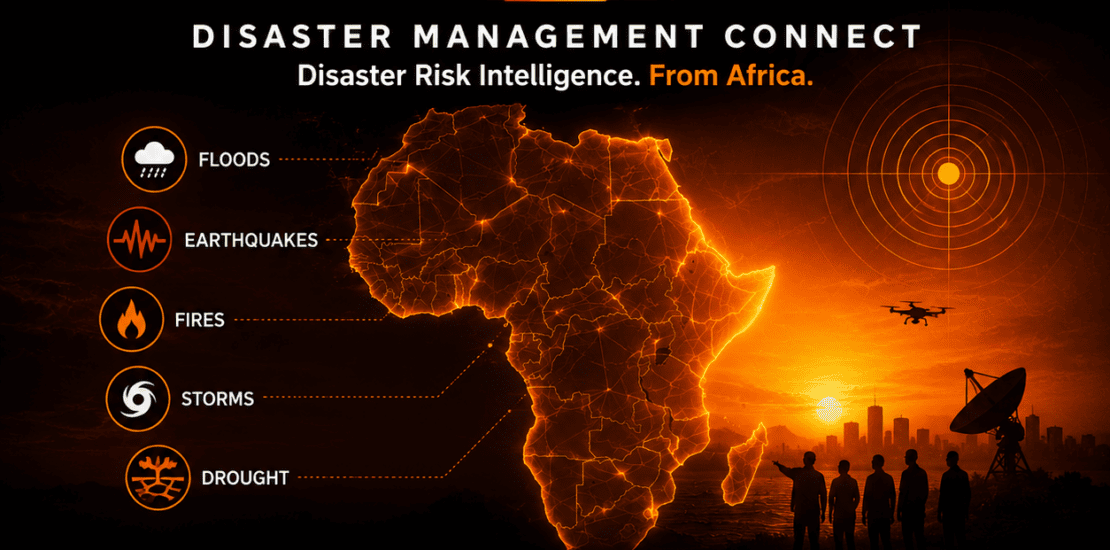
Disaster Management Connect | Disaster Risk Intelligence. From Africa.
EL NIÑO IS HERE. AFRICA STILL HAS TIME TO ACT.
El Niño is now firmly established and expected to strengthen substantially over the coming months. Across Africa, however, its consequences will not be uniform: some regions face heightened flood risk, others drought, extreme heat, food-security pressures or combinations of interacting hazards.
The critical advantage is time.
Unlike many disasters, much of the emerging risk can already be anticipated. Regional climate centres are refining seasonal outlooks, governments are updating preparedness measures, and the Africa Early Warnings Forum has just concluded with a renewed continental commitment to turn warnings into early action.
The question for Africa is therefore not simply what El Niño will bring — but what governments choose to do before its impacts arrive.
IN THIS ISSUE: El Niño Watch • Africa DRR Watch • DIMA Lens • Regional & Systems Watch • Risk Radar • Events & Learning • Professional Opportunities
EL NIÑO WATCH | A VERY STRONG EVENT IS DEVELOPING
The World Meteorological Organization confirmed on 3 September that El Niño is firmly established and expected to strengthen further. Forecasts from WMO Global Producing Centres indicate a near-100% likelihood that El Niño will persist through February 2027, with the event forecast to reach very strong intensity before peaking towards the end of 2026.
A strong El Niño can substantially alter rainfall and temperature patterns and increase the risks of floods, drought and extreme heat. But El Niño does not mean the same thing everywhere. Its effects vary according to geography, season and interaction with other climate drivers. Preparedness must therefore follow regional, national and increasingly sub-national forecasts — not generic assumptions.
DIMA WATCH: The operational question is no longer simply “Will El Niño affect us?” It is: “What does the latest forecast require us to do now?”
Official source: WMO El Niño/La Niña Update
AFRICA DRR WATCH | 31 AUGUST–6 SEPTEMBER 2026
Eastern & Southern Africa | 162 million children exposed
UNICEF estimates that more than 162 million children — over two-thirds of all children in Eastern and Southern Africa — live in areas exposed to the effects of the strengthening 2026/27 El Niño. Threats include drought, extreme heat and flooding, with potential consequences for nutrition, health, safe water and sanitation, education and child protection.
Forecasts provide a narrow but critical window to identify vulnerable populations, pre-position supplies, strengthen health and WASH preparedness, protect critical services and activate anticipatory measures. Yet UNICEF reports that less than 1% of international humanitarian assistance is currently available for anticipatory action.
DIMA WATCH: Exposure does not automatically become disaster. Decisions taken during the preparedness window will help determine how much of today’s forecast risk becomes tomorrow’s humanitarian need.
Official source: UNICEF
Greater Horn | A wetter October–December season
ICPAC forecasts an increased likelihood of wetter-than-normal conditions across much of the Greater Horn during October–December 2026. The regional downscaled forecast indicates a 90% chance of enhanced rainfall over southern Ethiopia, central-to-southern Somalia and north-eastern Kenya. Enhanced rainfall may improve pasture and water availability, but excessive rainfall can increase flood, landslide, infrastructure and disease risks.
DIMA WATCH: Seasonal forecasts should be the beginning of preparedness — not the end of the forecasting process.
Official source: ICPAC
Nigeria | Testing the link between forecast and action
Nigeria’s 2026 flood outlook identifies 14,118 communities across 266 Local Government Areas in 33 states and the Federal Capital Territory as facing high flood risk. NEMA has also activated a Fusion and Trigger Room concept intended to strengthen coordination and trigger early action when flood and climate-related risks reach critical thresholds.
DIMA WATCH: The success of a trigger system should be measured by what happens when a threshold is crossed: Who decides? What action follows? How quickly does financing move? And does that action reach exposed communities before impact?
Official source: NEMA Nigeria
THE DIMA LENS | PREPAREDNESS HAS A CLOCK
Preparedness is easiest to postpone precisely when it is most valuable. The skies may still be clear. Rivers may still be within their banks. Crops may still be standing. Hospitals may not yet be overwhelmed. That apparent normality creates a dangerous institutional temptation: to wait.
Yet the period before visible crisis is exactly when governments have the greatest range of options and when preventive action can often be undertaken at the lowest cost. Once flooding begins, drought intensifies, crops fail or populations move, the range of choices narrows rapidly.
FORECAST → PREPAREDNESS WINDOW → IMPACT
Every week lost reduces the time available to pre-position supplies, clear drainage, protect infrastructure, reinforce disease surveillance, prepare evacuation routes, safeguard livestock and crops, activate contingency financing, communicate with exposed communities and clarify institutional responsibilities.
DIMA INSIGHT: The true value of forecasting is not merely knowing the future more accurately. It is buying time to change the outcome. El Niño therefore presents Africa with more than a climate threat. It presents a governance test.
REGIONAL & SYSTEMS WATCH | ADDIS ABABA SETS THE NEXT TEST
More than 400 experts and officials from governments, regional institutions and international partners gathered in Addis Ababa from 2–4 September for the Africa Early Warnings Forum. The number of African countries reporting multi-hazard early-warning systems has risen from 14 in 2015 to 41 in 2026, while reported comprehensiveness has more than doubled since 2022.
The Forum concluded with the Addis Ababa Call to Action on Early Warnings in Africa, prioritising continued political commitment; closing remaining gaps and reaching the last mile; treating multi-hazard early-warning systems as core public investment; enabling early action based on warnings; and making universal protection a shared and measurable responsibility.
DIMA SYSTEM SHIFT: Technical systems generate intelligence. Institutions must convert intelligence into protection. That requires mandates, coordination, financing, accountability and functioning links between continental, regional, national and local systems.
Official source: UNDRR — Africa Early Warnings Forum outcome
DIMA RISK RADAR | WHEN ONE HAZARD BECOMES ANOTHER
The Greater Horn illustrates why El Niño preparedness cannot be organised around isolated hazards. Earlier outlooks identified significantly drier-than-normal conditions across northern parts of the region during July–September, followed by an increased likelihood of wetter-than-normal conditions across many equatorial and southern areas during October–December.
DRY CONDITIONS → LIVELIHOOD STRESS → FOOD INSECURITY → INTENSE RAINFALL → FLOODING → INFRASTRUCTURE DISRUPTION → MARKET ISOLATION → DEEPER VULNERABILITY
DIMA LENS: African disaster institutions increasingly need the capacity to manage compound, cascading and interacting risks, rather than treating drought, flood, health, food security and infrastructure disruption as entirely separate problems.
Source: ICPAC — Dual Climate Risks
EVENTS, LEARNING & DIMA RADAR
16 September | Learning from disasters through event analyses — Online
UNDRR webinar on using event analyses to strengthen resilience and preparedness.
16–30 September | AI for Multi-Hazard Early Warning Systems — Online
UNDRR masterclass series focused on practical uses of AI to strengthen early warning and response.
22 September | Strengthening West Africa’s Preparedness for the 2026 El Niño — Online
A UNDRR-listed webinar examining the roles of UCPM, Copernicus, ACMAD, AGRHYMET and NASRDA in addressing climate risks.
DIMA OPPORTUNITIES | LIVE & VERIFIED
Only new opportunities are included, except where a previously listed opportunity has materially changed. Always confirm eligibility and submission requirements on the official page.
JOB | Assistant Data Specialist, NOA
UNDRR | Cairo, Egypt
Deadline: 14 September 2026 — updated deadline
Supports DELTA-Resilience, Sendai Framework Monitor reporting, disaster loss and damage data, the Global Disaster-Related Statistics Framework and risk-informed planning. This national professional post requires Egyptian nationality.
JOB | WASH Officer, NO-1
UNICEF | Luanda, Angola
Deadline: 25 September 2026
Supports integration of climate resilience, disaster risk reduction, anticipatory action and emergency preparedness across programme sectors, alongside climate-resilient WASH and humanitarian preparedness.
VIEW OFFICIAL UNICEF VACANCY / APPLY
JOB | WASH Specialist, NO-3
UNICEF | Luanda, Angola
Deadline: 20 September 2026
Provides technical leadership for equitable, climate-resilient and sustainable WASH services, with relevance to preparedness, anticipatory action and humanitarian response.
VIEW OFFICIAL UNICEF VACANCY / APPLY
JOB | Humanitarian Affairs Specialist — Access & Civil-Military Coordination, P-4
UNICEF | Port Sudan, Sudan
Deadline: 15 September 2026
A senior humanitarian role focused on access, principled engagement, negotiations and creating conditions for timely and equitable assistance and protection in a complex emergency environment.
VIEW UNICEF SUDAN VACANCIES / APPLY
JOB | Partnerships Manager, P-4
UNICEF | Kinshasa, Democratic Republic of the Congo
Deadline: 15 September 2026
Senior role covering partnership development, resource mobilisation, external relations and stakeholder engagement in one of Africa’s most complex humanitarian and development environments.
VIEW UNICEF DRC VACANCIES / APPLY
FIRM / EOI | Strengthening Gender-Responsive Planning and Budgeting in Transition Countries
African Development Bank | Home-based | South Sudan, Guinea-Bissau & The Gambia
Deadline: 21 September 2026
The assignment will strengthen integration of gender equality into macroeconomic policy, planning, budgeting and public financial management, develop practical tools and strengthen government institutional capacity.
VIEW OFFICIAL AfDB EOI / APPLY
INTERNSHIP | Environment and Climate Change Unit
OHCHR | Geneva, Switzerland | In person, six months
Deadline: 19 September 2026
The internship supports research, drafting, environmental-rights events, monitoring of environmental crises and scientific developments, and engagement around multilateral environmental agreements and Human Rights Council processes. The UN internship is unpaid.
VIEW OFFICIAL UN VACANCY / APPLY
Opportunities re-verified on 7 September 2026.
FROM ADDIS ABABA TO NATIONAL ACTION
The Africa Early Warnings Forum has ended. The implementation test now begins. Over coming months, DIMA will follow whether continental and regional commitments translate into national preparedness measures, anticipatory-action triggers, contingency financing, sector planning, local-government readiness, last-mile communication and measurable protection of exposed communities.
We will follow evolving forecasts and preparedness across the continent, including IGAD/ICPAC, SADC/SARCOF, ECOWAS/CILSS/AGRHYMET, ECCAS/PRESAC, ACMAD, the African Union and national meteorological and disaster-management institutions.
ONE QUESTION TO TAKE AWAY
When a government has credible information about what may happen months before impact, at what point does waiting cease to be caution — and become a failure of preparedness?
ABOUT DIMA CONNECT
DIMA Connect — Disaster Management Connect is a weekly African disaster-risk intelligence brief tracking disaster risk management and reduction, climate resilience, early warning, anticipatory action, humanitarian developments, regional institutions, events and professional opportunities.
Have intelligence for DIMA? Send verified disaster-risk developments, research, events and professional opportunities to info@gravitazzcontinental.com.
DIMA Connect is produced by Gravitazz Institute, with contributions from the Gravitazz Continental Consortium — an Africa-led specialist network connecting expertise in risk, resilience, climate, humanitarian action, recovery, data and institutional strengthening.
JOIN THE DIMA CONNECT COMMUNITY
Exchange operational intelligence, opportunities, resources and practitioner insight with Africa’s growing disaster-risk community.
JOIN THE DIMA WHATSAPP COMMUNITY
RECEIVE DIMA EVERY MONDAY
English | Français | Português | Kiswahili | + other available languages
CONTACT / INTELLIGENCE / OPPORTUNITIES
info@gravitazzcontinental.com
www.gravitazzcontinental.com
Tracking the risks. Questioning the systems. Connecting the people who manage them.