
DIMA CONNECT | ISSUE 05 — 15 SEPTEMBER 2026
- September 15, 2026
- Posted by: Gravitazz Continental Online
- Categories: Climate Resilience & Early Warning, DIMA Connect, Disaster Risk Management
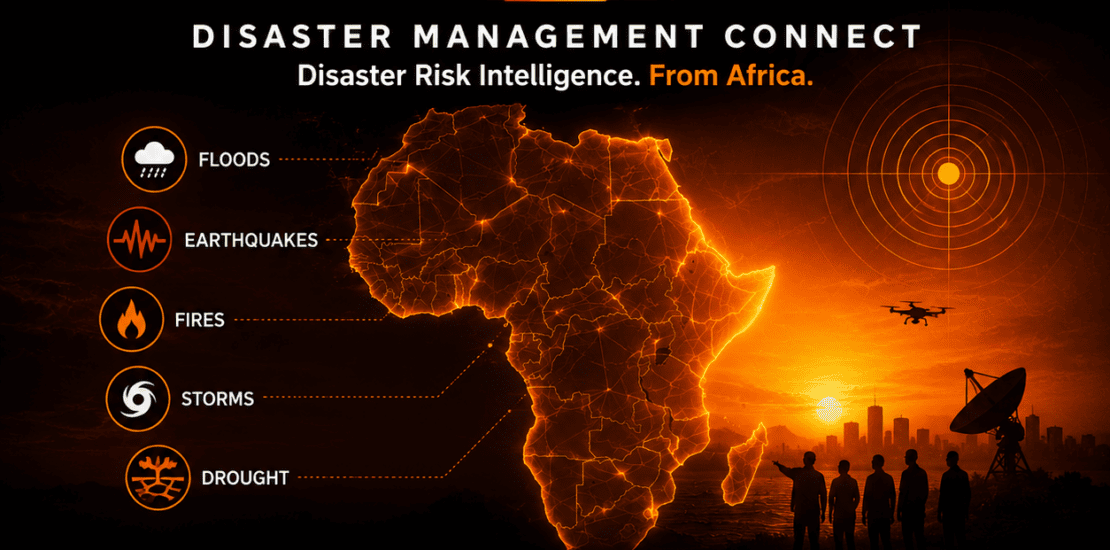
Disaster Management Connect | Disaster Risk Intelligence. From Africa.
WHEN RISKS COLLIDE
Why Africa’s disaster systems must prepare for compound, cascading and interconnected emergencies.
A disease outbreak unfolds amid armed conflict and displacement. Flood warnings emerge while communities already face food insecurity, drought and fragile infrastructure. A cyclone cuts electricity, communications and access to healthcare at the same time.
These are not separate crises occurring conveniently one after another. They interact, reinforce one another and place simultaneous pressure on institutions usually organised to manage risks independently.
DIMA SIGNAL: Africa’s harder preparedness challenge is no longer only identifying individual hazards. It is anticipating what happens when risks collide.
IN THIS ISSUE: Ebola and intersecting vulnerabilities • Somalia’s converging risks • SADC climate-to-action coordination • Mozambique’s drone capacity • Emergency medical teams • Education resilience • Live opportunities
DRC EBOLA OUTBREAK | A COLLISION OF RISKS
The Democratic Republic of the Congo is confronting a major outbreak of Ebola disease caused by the Bundibugyo virus. As of 7 September 2026, the country had reported 6,757 confirmed cases and 3,267 deaths—a crude case-fatality ratio of 48.3%. Cases had been recorded across 61 health zones in six provinces, with Ituri remaining the epicentre.
The outbreak is unfolding amid armed conflict, insecurity, displacement, overcrowding and inadequate access to healthcare, water and sanitation. More than 26 million people face acute food insecurity, while approximately one million internally displaced people live in Ituri Province alone.
These conditions obstruct surveillance, contact tracing, safe referral, infection control and early treatment. More than 24,700 identified contacts required follow-up during one 24-hour period reported by WHO.
WHEN RISKS COLLIDE: Disease outbreak + conflict + displacement + food insecurity + weak essential services = an emergency substantially harder to contain.
WHO assesses the risk within the DRC as very high and the risk to neighbouring countries sharing land borders as high. It advises against travel or trade restrictions and calls for stronger cross-border coordination, surveillance and preparedness.
Official source: WHO Disease Outbreak News, 10 September 2026
THE DIMA LENS | COMPLEXITY NEEDS PRECISE LANGUAGE
- Compound risk: Two or more hazards or risk drivers combine or occur concurrently. Flooding during an outbreak can amplify exposure and complicate response.
- Cascading risk: Disruption in one system triggers consequences in others. Flooding may interrupt electricity, water treatment, transport and healthcare.
- Systemic risk: Disruption spreads through interconnected social, economic, environmental and institutional systems.
- Polycrisis: Several major crises interact so deeply that their combined effects become more damaging and difficult to manage than each crisis alone.
Why risks collide
Risks do not collide merely because several hazards exist at once. Their interaction is shaped by exposure, vulnerability, institutional authority and response capacity. A biological hazard becomes harder to control where communities lack trusted information, safe water, accessible healthcare and secure livelihoods. Flood losses rise where drainage, land-use regulation and infrastructure maintenance are weak.
THE DRC COLLISION PATHWAY: EBOLA → HEALTH PRESSURE → ACCESS CONSTRAINTS → SERVICE DISRUPTION → REGIONAL RISK
DIMA WATCH: The initial hazard matters, but so do the conditions into which it arrives. Risk analysis must identify dependencies before disruption travels through them.
Trust is emergency infrastructure
Trust influences whether people report symptoms, accept referral, follow evacuation guidance, participate in vaccination, cooperate with responders and reject dangerous rumours. Community engagement must be built into preparedness, simulations, warning systems and financing—not added after escalation.
Five questions for disaster institutions
- Which hazards and vulnerabilities are most likely to interact?
- Which essential services could fail if electricity, water, transport or communications are disrupted?
- Who can activate multisectoral coordination before impacts escalate?
- Can local, national and cross-border institutions exchange usable information quickly?
- Is financing available for early action, or only after severe losses?
AFRICA DRR WATCH | CONVERGING RISK AND RESPONSE
Somalia | Preparing for several futures at once
UNDRR’s current El Niño climate-impact outlook examines how possible flooding, drought, extreme heat and disease may interact with food insecurity, displacement and infrastructure vulnerability during the October–December Deyr season. The Jubba and Shabelle corridors are particular areas of concern if El Niño strengthens alongside a positive Indian Ocean Dipole. This is a credible scenario—not a certainty.
PREPAREDNESS PRIORITY: Finalise anticipatory-action triggers, strengthen evacuation planning, improve health and WASH readiness, prepare for compounded displacement and connect early financing to recovery.
Official source: UNDRR Somalia climate-impact outlook
Southern Africa | Connecting forecasts to emergency decisions
On 8–9 September, the SADC Climate Services Centre and SADC Humanitarian and Emergency Operations Centre joined meteorological agencies, disaster-risk institutions and partners in Durban to improve the connection between weather and climate services and emergency operations across floods, droughts, cyclones and extreme heat.
DIMA SYSTEM TEST: Who receives the warning? Who interprets it? Who authorises action? What financing moves? How does the warning reach exposed communities?
PROMISING PRACTICE | MOZAMBIQUE BUILDS LOCAL DRONE CAPACITY
Mozambique has trained 30 certified local drone operators for search and rescue, rapid mapping, surveillance, water-quality monitoring and warning-system data collection. The technology was deployed during the January floods and highlighted by the African Development Bank on 9 September.
The strongest feature is not the equipment; it is locally held operational capacity. The next test is whether drone use is embedded in standard procedures, legally authorised, sustainably financed and connected to emergency-centre decisions.
REGIONAL AND SYSTEMS WATCH
Emergency medical teams
African health ministers have adopted a 2026–2030 regional framework intended to help every country establish at least one functional national emergency medical team by 2030. Implementation requires teams to be trained, equipped, financed, accredited and integrated with disaster authorities, operations centres and regional mutual assistance.
Education in Emergencies and Resilience Cluster
The African Union is scheduled to launch its Education in Emergencies and Resilience Cluster on 18 September in hybrid format from Addis Ababa. Under CESA 2026–2035, it will establish governance arrangements, validate an initial workplan and mobilise Member States and partners. Education continuity belongs in disaster planning because school disruption can cascade into protection, nutrition, displacement and livelihood pressures.
ONE QUESTION TO TAKE AWAY: Are Africa’s disaster institutions preparing for individual hazards—or for the chain of consequences that begins when risks collide?
DIMA OPPORTUNITIES | LIVE AND VERIFIED
Only new, relevant opportunities with usable application time are included. No opportunity closing today is listed. Always confirm eligibility and submission requirements on the official page.
Economic Affairs Officer, P-4
UNDRR | Geneva, Switzerland | Deadline: 3 October 2026
Senior professional post focused on DRR financing, risk-informed investment, economic analysis and policy support.
VIEW OFFICIAL OPPORTUNITY / APPLY
Knowledge Management and Stakeholder Communication Consultant
African Development Bank / Africa Circular Economy Facility | Home-based | Deadline: 21 September 2026
Individual consultancy covering climate, green growth, knowledge translation and stakeholder engagement.
VIEW OFFICIAL OPPORTUNITY / APPLY
Water4All 2026 Joint Transnational Call
European Partnership Water4All | International research consortia | Pre-proposals: 10 November 2026
Research and innovation funding for sustainable water management, with an indicative call budget of approximately €34 million. Eligibility and participating-country rules apply.
Opportunities re-verified on 15 September 2026.
ABOUT DIMA CONNECT
DIMA Connect — Disaster Management Connect is a weekly African disaster-risk intelligence brief tracking disaster risk management and reduction, climate resilience, early warning, anticipatory action, humanitarian developments, regional institutions, events and professional opportunities.
DIMA Connect is produced by Gravitazz Institute, with contributions from the Gravitazz Continental Consortium—an Africa-led specialist network connecting expertise in disaster risk, climate resilience, humanitarian action, recovery, data, innovation and institutional strengthening.
Consultancies and technical support
Gravitazz Institute and the Gravitazz Continental Consortium support governments, regional institutions, development partners and organisations through consultancies, research, training, evaluations, policy and strategy development, institutional strengthening, programme design and consortium delivery across Africa.
Have intelligence for DIMA? Send verified developments, research, events, learning resources and professional opportunities to info@gravitazzcontinental.com.
JOIN THE DIMA WHATSAPP COMMUNITY
READ DIMA CONNECT IN YOUR LANGUAGE: English | Français | Português | Kiswahili | Arabic | other available languages
info@gravitazzcontinental.com | www.gravitazzcontinental.com
Tracking the risks. Questioning the systems. Connecting the people who manage them.