
DIMA CONNECT | ISSUE 07 — 29 SEPTEMBER 2026
- September 29, 2026
- Posted by: Gravitazz Continental Online
- Categories: Climate Resilience & Early Warning, DIMA Connect, Disaster Risk Management, Uncategorized
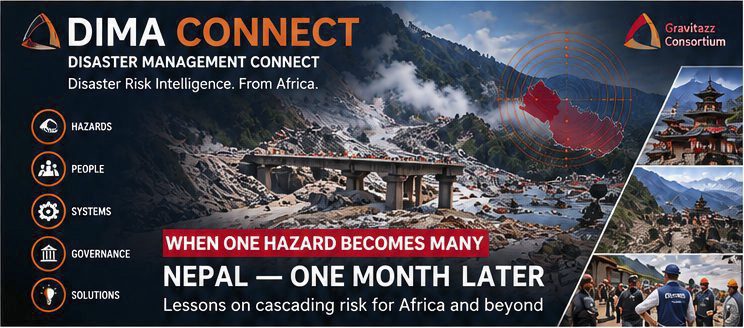
SEPTEMBER INVESTIGATION | WHEN RISKS COLLIDE
WHEN ONE HAZARD BECOMES MANY
NEPAL — ONE MONTH LATER
The disaster was introduced in DIMA Connect Issue 03. One month on, the more useful question is not simply what happened — but how the response performed, where systems bent or broke, and what African institutions can learn.
On 26 August, a glacier-and-bedrock collapse high in the Himalayas triggered a fast-moving cascade through the Lhende–Bhote Koshi–Trishuli river system. A month later, Nepal is simultaneously managing emergency relief, infrastructure restoration, disease prevention, education continuity and the first decisions of a long recovery. The sequence matters because the initial physical event was only the beginning.
One month later, the cascading impacts remain the story: damaged transport links, disrupted health services, difficult access to affected communities and continuing public-health risks.
READ THE WHO NEPAL EMERGENCY UPDATE →
THE RESPONSE | WHAT HAS WORKED — AND WHAT REMAINS EXPOSED
WHAT HAS WORKED. Government-led coordination through NDRRMA and the Ministry of Home Affairs, linked to UN, IFRC, Member State and humanitarian support. Air logistics reached cut-off communities. Health action moved before secondary outbreaks, while temporary learning arrangements supported continuity for affected children.
WHAT REMAINS EXPOSED. Road and bridge failure quickly became an access, market, service-delivery and livelihood problem. Energy and communications were part of the same cascade. Recovery now faces harder questions around safe settlement, debris removal, livelihood restoration, rebuilding standards and high-mountain risk across borders.
DIMA CONNECT SIGNAL: The most dangerous disaster may not be the first event. It may be the chain of consequences that the first event sets in motion.
THE DIMA CONNECT LENS | CASCADING RISK IS A SYSTEMS PROBLEM
THE DISASTER PATHWAY IS LONGER THAN THE HAZARD
Nepal shows why preparedness cannot stop at identifying the initiating hazard. Institutions need to understand dependencies: what fails next, who owns that failure, and what must keep functioning when roads, power, communications or public services are disrupted together.
CRYOSPHERE / SLOPE FAILURE → RIVER SURGE + DEBRIS → ROADS / BRIDGES → ENERGY / TELECOM → ACCESS / SERVICES → RECOVERY / RELOCATION
FIVE LESSONS — ONE MONTH LATER
1. Coordination architecture matters. Coordination is a preparedness asset, not an administrative afterthought.
2. Logistics is part of resilience. When roads disappear, supply chains, market access, referral systems and relief delivery disappear with them.
3. Secondary risks must be acted on early. Health surveillance and continuity of essential services can prevent one disaster becoming another.
4. Recovery begins before relief ends. Debris mapping, local-government support, temporary learning spaces and infrastructure assessment shape the recovery pathway while humanitarian needs continue.
5. Transboundary information is operational infrastructure. Monitoring, data exchange and warning arrangements must work across institutions and jurisdictions within very short lead times.
DIMA CONNECT SYSTEM TEST: Your risk register may list floods, landslides, power failure and displacement separately. Does your contingency planning show how one can trigger the others?
DIMA CONNECT FIELD NOTE | SADC DRM PEER REVIEW — ESWATINI
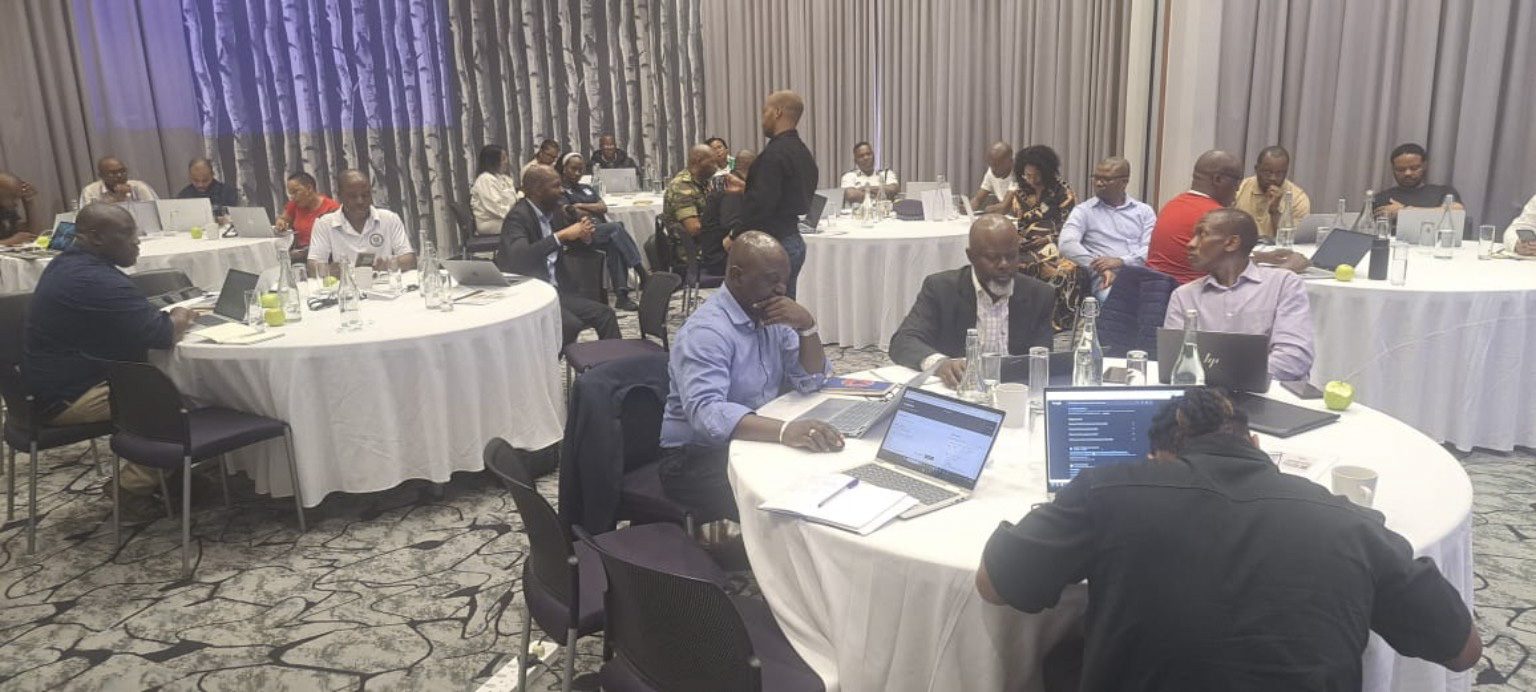
CAN INSTITUTIONAL SEAMS BE FOUND BEFORE A DISASTER FINDS THEM?
This week the SADC Disaster Risk Management Peer Review process moved into Eswatini. The exercise brings national stakeholders and regional peers together to examine the institutional machinery behind disaster risk management: mandates, policy and legislation, coordination, preparedness, risk information, implementation capacity and the connections between national and local systems.
The relevance to this month’s investigation is direct. Cascading emergencies test the seams between institutions. A peer review can help identify those seams before a disaster does.
Gravitazz is supporting the SADC Secretariat in the development and application of the emerging SADC DRM Peer Review Mechanism. DIMA Connect draws general practitioner lessons from the process while protecting confidential country findings, scoring and deliberations.
FROM THE FIELD: Peer review should not ask only whether an institution exists. It should ask whether the system can still coordinate when several things go wrong at once.
AFRICA DRR WATCH | WHAT THE INSTITUTIONS ARE DOING
THE CONTINENTAL STORY IS MOVING THROUGH INSTITUTIONS
This week’s scan goes beyond hazard headlines. DIMA Connect is watching whether continental and regional systems are converting risk information into mandates, finance, preparedness and practical capability.
AU / CONTINENTAL | FROM ADDIS ABABA TO ACTION. The Africa Early Warnings Forum brought together close to 500 experts and officials from 44 countries earlier this month. Today, 29 September, the continental follow-up turns explicitly to implementation of the Addis Ababa Call to Action. DIMA CONNECT WATCH: coverage is not the same as effectiveness; last-mile reach, financing, coordination and decision authority remain central.
WEST AFRICA | WET IN THE SOUTH, DRY STRESS IN THE SAHEL. Regional monitoring continues to show why averages can mislead: flood pressure and heavy rainfall can coexist with dry spells and pastoral stress elsewhere. Preparedness must be spatially differentiated.
HORN / IGAD | THE FORECAST IS NOW A PREPAREDNESS INSTRUCTION. Today’s operational picture sharpens the question. ICPAC’s 28 September Hydromet Flood Bulletin forecasts extreme rainfall over Kampala, Masaka, Mukono, Hoima, Kanungu, Kabarole and Kamuli in Uganda, with severe rainfall in additional districts; severe rainfall is also forecast in parts of South Sudan. DIMA CONNECT WATCH: the test is now what institutions do before impact.
VIEW THE ICPAC FLOOD BULLETIN →
SOUTHERN AFRICA / SADC | CONNECTING CLIMATE SERVICES TO OPERATIONS. Regional climate and emergency-operation institutions are strengthening coordination around early warning and preparedness. The institutional question is whether climate information, authority and operational capability connect before a cascading event.
CENTRAL AFRICA / ECCAS | FORECASTS MUST ENTER DECISIONS. Regional climate forums continue to strengthen the user–provider interface. DIMA Connect will keep watching how consistently regional products become national DRM and sector decisions.
AFRICAN ISLAND STATES | RESISLANDS MOVES INTO IMPLEMENTATION. Mauritius officially launched its national component of the US$4.943 million RESIslands programme on 25 September. The nine-island initiative focuses on institutional capacity for risk assessment and multi-hazard disaster management. DIMA CONNECT WATCH: the real test will be whether shared learning translates into national capability.
READ MORE — UNECA / RESISLANDS →
GLOBAL DRR WATCH | WHAT AFRICA CAN LEARN
INTERCONNECTED INFRASTRUCTURE. International DRR practice is increasingly focusing on how failures cascade across energy, transport, digital systems and water. DIMA CONNECT LESSON: map dependencies before they become emergency surprises.
CAPABILITY-BASED PLANNING. A useful shift is from preparing separately for every hazard toward identifying the capabilities — warning, continuity of essential services, logistics, communications and cross-border cooperation — that must survive many hazards.
LOCAL RESILIENCE. Peer exchange is strongest when it moves from policy language to local operating practice.
DIMA CONNECT RADAR | EVENTS & LEARNING
29 SEP | AFRICA EARLY WARNINGS FORUM WEBINAR — FROM ADDIS ABABA TO ACTION
14:00–15:30 EAT. Continental follow-up focused on accelerating implementation.
EVENT & REGISTRATION →
7 OCT | WMO WEBINAR — CASCADING FLOOD RISKS IN MOUNTAIN REGIONS
Early warning, governance and resilience.
12–14 OCT | 2ND ARAB FORUM ON EARLY WARNING SYSTEMS AND DISASTER PREPAREDNESS
Tunis.
DIMA CONNECT OPPORTUNITIES | LIVE AND VERIFIED
UNDRR | EOI — TECHNICAL SERVICES IN DISASTER RISK REDUCTION
Service providers supporting risk assessment, data systems, early warning/anticipatory action and technical DRR systems. Deadline: 22 October 2026.
VIEW OFFICIAL EOI →
AFRICAN UNION | HYDROMET & DRR TRAINING PROGRAMME CONSULTANCY
Training for senior Hydromet/DRR practitioners across participating countries and regional entities. Deadline: 8 October 2026.
VIEW OFFICIAL AU NOTICE →
AFRICAN UNION | AMERT SYSTEM SUPPORT — INDIVIDUAL CONSULTANT
Support to the Africa Monitoring, Evaluation and Reporting Tool. Deadline: 9 October 2026.
VIEW OFFICIAL AU NOTICE →
Only opportunities with a current, directly verified official notice are listed here.
SEPTEMBER INVESTIGATION | THE THREAD
Issue 05 asked what happens WHEN RISKS COLLIDE. Issue 06 tested whether warning becomes institutional action. Issue 07 closes the September investigation by asking what institutions must do WHEN ONE HAZARD BECOMES MANY.
THE SEPTEMBER ARGUMENT: Understand interacting risks → connect warning to authority and finance → build institutions capable of managing cascading consequences.
THE DIMA CONNECT QUESTION
IF ONE CRITICAL SYSTEM FAILED TOMORROW, WHICH OTHER SYSTEMS WOULD FAIL NEXT — AND DOES YOUR PREPAREDNESS PLAN ALREADY KNOW THE ANSWER?
ABOUT DIMA CONNECT
DIMA Connect — Disaster Management Connect is a weekly African disaster-risk intelligence brief produced by Gravitazz Institute, with contributions from the Gravitazz Continental Consortium.
Disaster Risk Intelligence. From Africa.
Tracking the risks. Questioning the systems. Connecting the people who manage them.
SHARE INTELLIGENCE
Tips, events, opportunities and field intelligence: info@gravitazzcontinental.com
www.gravitazzcontinental.com
READ DIMA CONNECT IN YOUR LANGUAGE | English | Français | Português | Kiswahili | Arabic | other available languages